How to Get Rid of Wasps Around Your House Safely
How to get rid of wasps around your house safely comes down to identifying the species, assessing nest size and location, and deciding whether DIY treatment is appropriate for the specific situation. Small paper wasp nests on exposed surfaces can sometimes be handled safely with aerosol wasp spray at dusk when workers are inside. Large nests, yellowjacket colonies, nests inside wall voids or soffits, and any situation involving ladder access or family members with sting allergies warrant professional removal. Treatment typically runs $150 to $400 depending on species, nest location, and property access.
How to Get Rid of Wasps: The Safety-First Approach
How to get rid of wasps around the house is a question that deserves a safety-first answer, because wasp stings can produce serious reactions in a meaningful percentage of the population and because many homeowner wasp situations are riskier than they initially appear. Before deciding on treatment approach, honest assessment of the specific situation matters: species, nest size, nest location, time of year, and household risk factors all affect what a safe response looks like.
Paper wasps, which are the most common nest-building wasps around Florida homes, are generally the least aggressive of the local wasp species and typically do not sting unless the nest is directly threatened. Their open-combed nests under eaves, soffits, and in outbuildings are the ones homeowners most often encounter. Yellowjackets, by contrast, are significantly more aggressive, defend their nests more vigorously, and can produce swarm-attack situations that paper wasps generally do not. Any yellowjacket nest, particularly ground-nesting colonies that are easy to disturb accidentally, warrants more caution.
The specific household factors that raise the stakes on any wasp situation include: any family member with known or suspected sting allergies, young children in the home who may approach a nest out of curiosity, pets that spend time in yard areas near nest locations, and any physical limitations on the homeowner that affect ability to retreat quickly if treatment goes wrong. When any of these apply, the balance tips toward professional removal regardless of nest size.
Identifying the Wasp Species Around Florida Homes
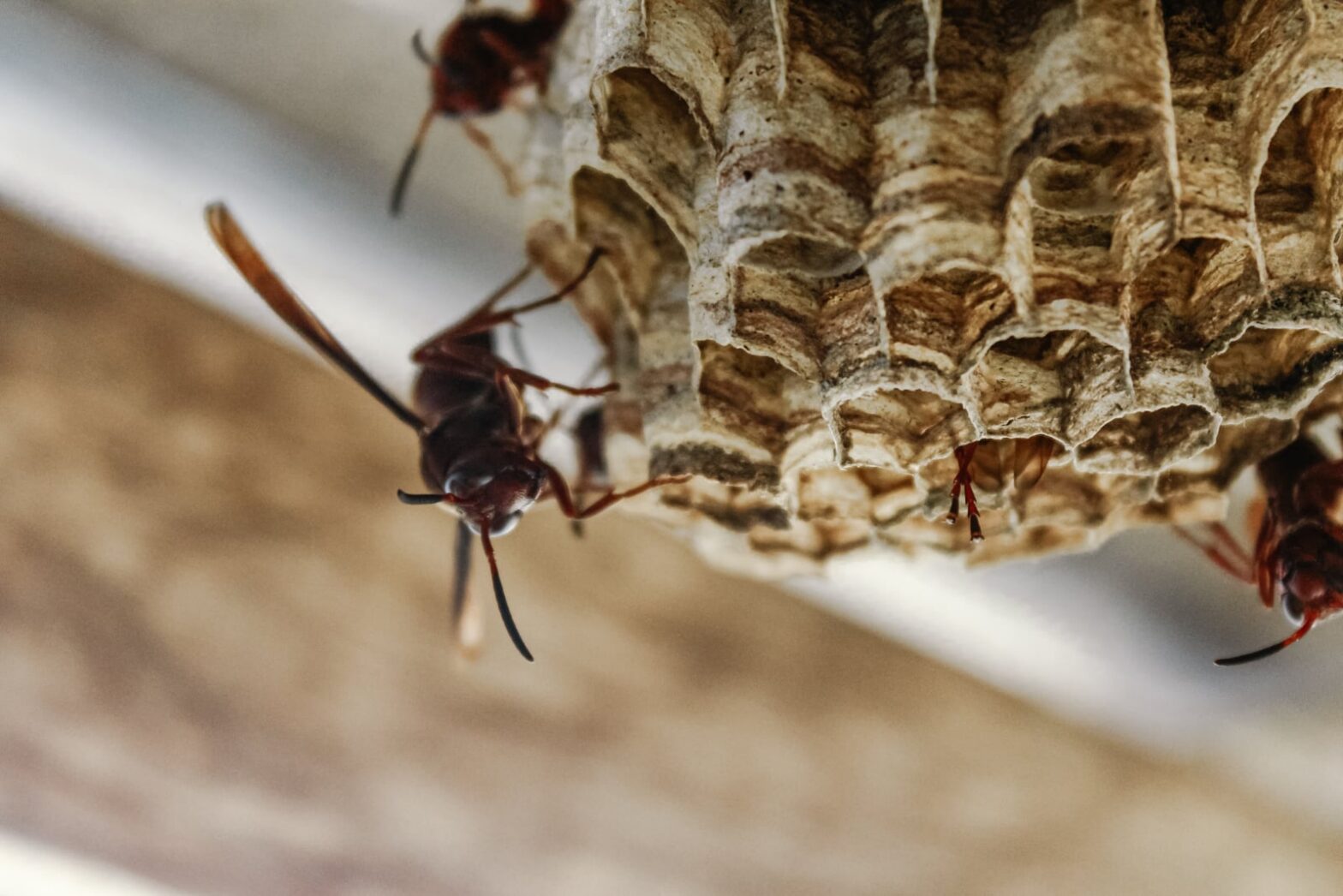
Several wasp species commonly appear around Florida homes, and treatment approach varies with species. Paper wasps (Polistes species) build the characteristic open-combed nests that look like small gray-brown umbrellas hanging from eaves, soffits, and outdoor structures. The nests are visible, the colonies are relatively small (typically 20 to 100 workers at peak), and the wasps themselves are slender with narrow waists and brownish or reddish coloration. They are generally non-aggressive unless the nest is threatened.
Yellowjackets (Vespula species) build enclosed nests, often in cavities: wall voids, under decks, inside soffits, or underground in old rodent burrows and leaf litter. The nests may be entirely hidden until a steady stream of workers coming and going reveals the entry point. Yellowjackets are more compact than paper wasps, bright yellow and black, and significantly more aggressive. Yellowjacket colonies can reach several thousand workers by fall, and disturbing a mature nest is genuinely dangerous.
Mud daubers build the distinctive mud tube nests often seen on exterior walls, garage ceilings, and under eaves. They are solitary rather than colonial, meaning each nest represents a single female wasp rather than a colony, and they are among the least aggressive wasps. Mud dauber removal is usually a matter of knocking down the mud tubes rather than treating a colony. Cicada killers are large intimidating wasps that nest in bare ground; despite their size, they rarely sting humans and typically do not warrant treatment.
When DIY Wasp Treatment Is Reasonable
DIY wasp treatment can be reasonable for specific situations: small paper wasp nests (fewer than roughly 30 workers), nest locations accessible from the ground or a very low ladder, no household members with sting allergies or elevated risk factors, and no obvious signs the nest has grown beyond what consumer-grade aerosol can handle. Under these conditions, standard aerosol wasp spray applied at dusk, when workers are inside the nest and ambient temperature has dropped, can produce a reasonable result.
The practical approach for DIY treatment: approach the nest at dusk from a direction that allows quick retreat, spray the aerosol product directly into the nest opening or across the comb face from the recommended distance (typically eight to twelve feet, per product instructions), ensure full saturation of the nest surface, and leave the area immediately. Return the following morning to confirm no activity, then remove the nest. Do not stand directly below the nest during treatment, as dropping workers and the nest itself can present hazards.
Several situations fall outside what DIY should attempt even for small paper wasp nests: any nest at height requiring a ladder for access (ladder-plus-wasps is a common injury scenario), any location where retreat is restricted (confined spaces, cluttered garages, enclosed porches), and any nest where the wasp species cannot be confidently identified. Misidentifying a yellowjacket nest for a paper wasp nest is a common and dangerous mistake.
Our licensed technicians identify the species, assess risk, and remove nests safely regardless of location. Same-day scheduling available for most situations. Family and pet-safe approach.
Request Nest Removal →When Professional Removal Matters
Professional nest removal is warranted for any yellowjacket colony, any nest inside a wall void or soffit (where DIY treatment often fails to reach the full nest and leaves surviving wasps to re-establish), any large paper wasp nest (more than roughly 50 workers), any ground-nesting situation that is difficult to approach safely, and any situation where the family has members with sting allergies or elevated risk factors. Professional treatment uses products not available to consumers and application methods designed to reach the full nest including workers inside cavities.
The specific risk of hidden cavity nests warrants emphasis. Yellowjackets establishing in wall voids can produce colonies with thousands of workers before homeowners notice meaningful activity, and attempting to spray at the entry point typically kills a small fraction of the colony while enraging the rest. Dust formulations applied through the entry point with professional equipment reach the full nest and produce elimination without the risk of partial treatment producing an aggressive response.
Pricing for professional wasp nest removal typically runs $150 to $400 in the local market depending on species, nest location and accessibility, number of nests, and whether structural work is needed to reach cavity nests. For context, that cost is modest compared to emergency room visits for severe sting reactions, which routinely cost $5,000 or more including follow-up care. The economics favor professional treatment whenever risk factors elevate the stakes.
How to Get Rid of Wasps Long-Term: Prevention and Exclusion
Removing an active nest does not prevent new nests from establishing, which is why ongoing wasp prevention matters as much as nest removal for homes that regularly see wasp activity. Spring is the critical period: queens emerging from overwintering seek nest sites in April and May, and homes that are inspected and treated prophylactically during this window see significantly fewer established colonies through the warm season.
Physical exclusion addresses the structural conditions wasps exploit. Soffit vents without proper screening allow queens to establish inside the void. Gaps around utility penetrations provide the same access to wall voids. Attic vents without quarter-inch hardware cloth let various wasp species in. Addressing these openings during spring reduces new nest establishment meaningfully, and the exterior perimeter treatment applied as part of general pest control deters queens from establishing near treated areas.
For properties with recurring wasp pressure, ongoing pest control that includes periodic eave and soffit inspection catches new nests when they are small and manageable rather than when they have reached the size that requires more intensive treatment. The Saela Pest Protection Program includes this inspection and treats small developing nests as part of quarterly service.
How Saela Handles Wasp Nest Removal
Saela's wasp service starts with species identification and risk assessment. Our licensed technicians identify whether the nest is paper wasp, yellowjacket, mud dauber, or another species, assess location and accessibility, and discuss any household risk factors (children, pets, sting allergies) before deciding on treatment approach. The treatment plan is walked through with the homeowner before work begins.
For exposed nests, direct application of a professional-grade formulation produces rapid elimination. For cavity nests (yellowjackets in wall voids, hidden soffit colonies), dust formulations applied through the entry point reach the full nest and eliminate it from the inside out. Nest removal following treatment is included in the service for accessible nests. The treated area is monitored on the following visit to confirm no re-establishment.
Family and pet safety underpin the approach. Treatment is scheduled for times when household activity is minimal (early morning or late afternoon), re-entry timing is discussed clearly, and products used are selected for their balance of effectiveness and safety around family. For homes on the Pest Protection Program, nest removal services are included at discounted rates and the inspection naturally catches new nests before they grow.
Saela's Pest Protection Program includes periodic eave and soffit inspection, treatment of small nests before they grow, and ongoing prevention. Family-safe products and the Saela Service Guarantee behind every visit.
Get a Free QuoteHave an active wasp nest or recurring wasp activity? Contact Saela for a free inspection and safe removal.
How to get rid of wasps around your house safely depends on honest assessment of the specific situation and the household risk factors it carries. Small paper wasp nests on accessible surfaces can sometimes be handled by homeowners who follow safety practices carefully. Yellowjackets, cavity nests, elevated nests, and any situation involving sting allergies or ladder work warrant professional removal. The Saela team handles both the one-time emergencies and the ongoing prevention that keeps wasps from establishing in the first place.
Frequently Asked Questions
The best approach depends on the species, nest size, nest location, and household risk factors. Small accessible paper wasp nests can sometimes be treated with consumer-grade aerosol applied at dusk. Yellowjackets, cavity nests inside wall voids or soffits, large nests, and any situation involving ladder access or sting allergies warrant professional removal. Misidentifying species or underestimating nest size is a common cause of DIY injuries, so when in doubt, professional treatment is the safer call.
Professional wasp nest removal typically runs $150 to $400 in the local market depending on species, nest location and accessibility, number of nests, and whether structural work is needed to reach cavity nests. Removal is often included or discounted for homes on an ongoing Pest Protection Program. Every quote is free and includes assessment of the specific situation before treatment begins.
DIY removal can be reasonable for small accessible paper wasp nests with no household risk factors. It is not reasonable for yellowjacket nests, cavity nests inside walls or soffits, large nests, nests requiring ladder access, or any situation involving family members with sting allergies. The specific risk of misidentifying a yellowjacket nest for a paper wasp nest, or underestimating cavity nest size, produces most of the DIY wasp injuries that end up in emergency rooms.
Florida sees wasp activity year-round but with peaks during the warm season. Queens emerge from overwintering in April and May and begin establishing nests. Colonies grow through summer, reach peak size in late summer and early fall, and begin breaking down in late fall. Fall is often when homeowners first notice nests because they have grown to visible size, and this is when yellowjacket activity is most aggressive. Professional treatment is appropriate throughout the active period.
Yes, through a combination of exterior perimeter treatment that deters nest establishment near treated areas, periodic eave and soffit inspection that catches small developing nests before they grow, and physical exclusion addressing soffit vents, utility penetrations, and other structural openings. Spring inspection is particularly valuable because it catches queens attempting to establish nests at the start of the season. The Saela Pest Protection Program includes these components as part of ongoing service.